
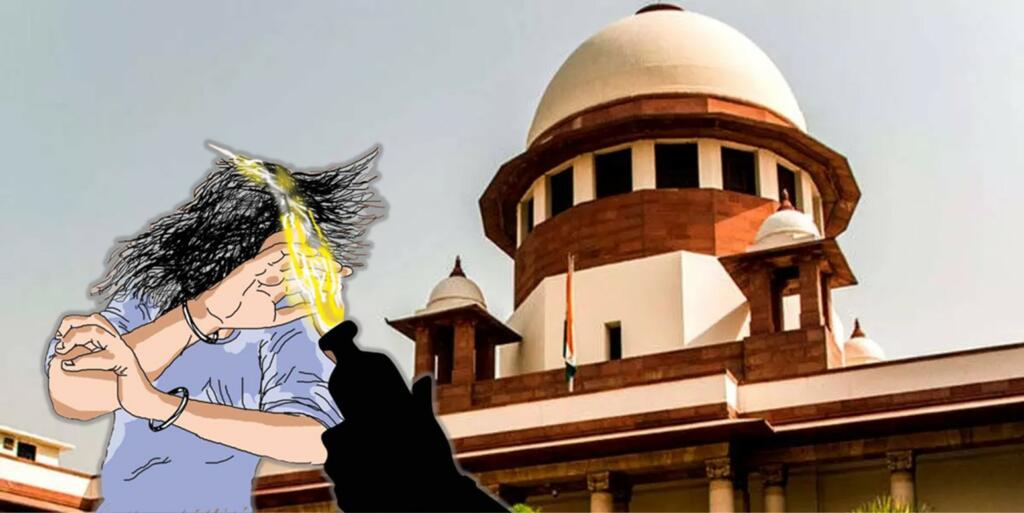
A Survivor’s Story Shaheen Malik and a Lifetime of Pain
Shaheen Malik then only 26 and pursuing an MBA was brutally attacked outside her workplace. The assault left her irreversibly disfigured, and she has since undergone 25 reconstructive surgeries. Her ordeal and long, painful process of survival are stark reminders of how acid attacks destroy lives physically, emotionally and socially. Despite facing unimaginable trauma, Malik turned survivor into a crusader: she filed a petition seeking justice not only for herself, but for countless other victims including those who suffer silently, forced to drink acid rather than being attacked externally, and who rarely get recognition or rehabilitation.

Judiciary Breaks Silence CJI Surya Kant’s Unanimous Stance
On December 4, 2025, the Supreme Court bench of Chief Justice Surya Kant and Justice Joymalya Bagchi took up Malik’s petition and delivered a scathing rebuke of the state of acid-attack justice in India. The Court after hearing compelling testimony from Malik called the prolonged trial (in her case dating back to 2009) “a shame… a mockery of the system.” India Today+2www.ndtv.com+2
CJI Surya Kant made a powerful statement: “There should be no sympathy for such persons [acid-attack accused]. These cases should be tried by special courts.” He emphasised the need for day-to-day, expedited trials, so survivors aren’t forced to wait endlessly for justice. Hindustan Times+1
Beyond Judgement Survivors’ Rights, Rehabilitation, and Legal Reform
The Court also raised attention to a deeply troubling aspect of acid crimes: in many cases, victims are forced to drink acid causing internal injuries that leave them with disabilities, unable to eat or walk, often dependent on feeding tubes. These survivors, as the Court observed, have received little or no recognition under existing laws. www.ndtv.com+1
To remedy this, the bench directed the Union government to consider amending the Rights of Persons with Disabilities Act, 2016 to explicitly include acid-attack survivors granting them access to disability benefits, reservation in employment/education, and long-term rehabilitation support. India Today+1
The Court also ordered that all High Courts across India must submit details of pending acid-attack cases ensuring transparency, accountability and a nationwide audit of the justice backlog. Live Law+1
What This Means for Survivors and Society
For survivors like Malik and many others who have suffered unspeakable trauma these developments offer a glimmer of hope. The Court’s firm words signal a shift in the institutional mindset: acid violence will no longer be met with leniency or delay. A call for special courts, rapid trials, disability recognition, and rehabilitation shows that justice is not only about punishment but about restoring dignity and life.
At the same time, the judgment shines light on broader systemic failures: delays spanning decades, inadequate recognition of non-visible injuries, and a lack of social support for survivors. The SC’s intervention is a wake-up call to lawmakers, medical authorities, state governments and civil society urging them to build a robust framework: inclusive laws, free reconstructive care, psychological counselling, social security, and rehabilitative opportunities.
A Chance for Redemption For Survivors, and for the System
Today, when courts say “no sympathy” for perpetrators, they speak for every survivor waiting for justice. When laws are amended to recognise acid-attack survivors as persons with disabilities, they restore lost rights, hope and opportunity. When trials move day-by-day they signal a nation unwilling to let justice languish in delay.
The fight of Shaheen Malik and countless others must now become a turning point. For every scar they bear, there must be a committed effort to ensure protection, rehabilitation and dignity. Because no human being, ever, should be condemned to a lifetime of pain for the crime of surviving