
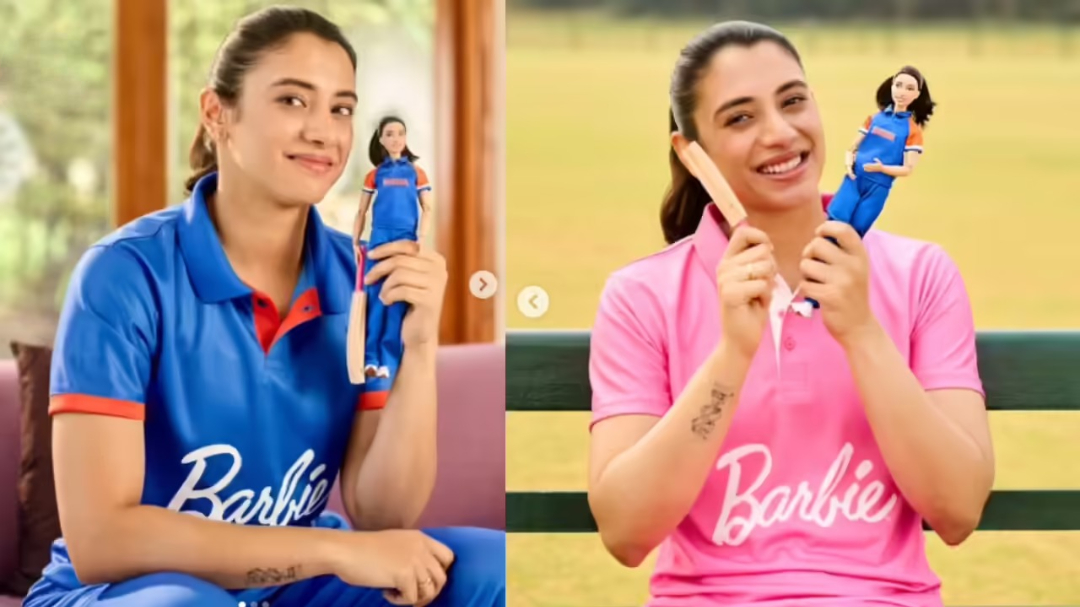
When Smriti Mandhana was announced as part of Barbie’s first-ever ‘Dream Team’, becoming the first cricketer in the world to receive a doll in her likeness, it marked more than just a celebratory tribute. It signaled a cultural shift in how role models especially women athletes are represented in global popular culture.
For decades, Barbie, created by Mattel, has been associated with a narrow image of beauty. The doll often reflected a highly stylized standard tall, slim, glamorous which sparked debates across the world about unrealistic beauty expectations for young girls.
But in recent years, Barbie has been attempting to redefine that image.
By honoring women from diverse professions and backgrounds, the brand is slowly moving away from the idea that inspiration comes only from appearance. Instead, it is emphasizing achievement, ambition, and impact.
That is where Smriti Mandhana’s inclusion becomes powerful.
Mandhana represents a generation of women who have transformed the landscape of Indian sport. Through her performances for the India women’s national cricket team, she has not only won matches but also helped bring women’s cricket into mainstream conversation.
When a global toy brand chooses a female cricketer from India as a role model, it sends a message far beyond merchandising. It tells young girls that their heroes do not have to come from film screens or fashion magazines. They can come from stadiums, cricket fields, laboratories, or classrooms.
In many ways, this move also challenges long-standing cultural taboos. For generations, girls were often subtly discouraged from pursuing sports professionally. Athleticism was rarely part of the traditional “ideal girl” narrative.
A Barbie modeled after a cricketer quietly disrupts that narrative.
It tells young girls that strength, discipline, and sporting excellence are just as aspirational as glamour.
Representation matters especially in childhood imagination. The toys children play with shape the stories they tell about themselves and the possibilities they see in the future.
When a child holds a doll modeled after Smriti Mandhana, she is not just holding a toy. She is holding the idea that a girl from India can grow up to become a global sports icon.
For a brand long criticized for reinforcing beauty stereotypes, this shift toward celebrating real-world achievers is an important step.
Because sometimes, changing the world does not begin with a speech or a policy.
Sometimes, it begins with a doll that looks a little more like a hero.


https://shorturl.fm/QrlbJ
https://shorturl.fm/B9AS2
https://shorturl.fm/q4MoK
https://shorturl.fm/mKkVc