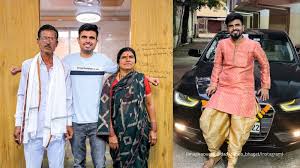
In a world driven by innovation, stories like that of Dadasaheb Bhagat prove that talent needs no pedigree. Hailing from a drought-prone village in Beed, Maharashtra, Bhagat’s journey from earning ₹4,000 a month to being praised by Prime Minister Narendra Modi is nothing short of extraordinary.
Born into a humble family with little emphasis on education, Bhagat completed only his 10th standard, followed by an ITI course aimed at blue-collar work. While his peers looked for steady government jobs, Bhagat’s curiosity for design and technology led him down a different path.
With limited resources but an abundance of grit, he started learning design software on his own and later developed a platform now dubbed as “India’s Canva”—an easy-to-use graphic design tool for local businesses, students, and content creators. The platform focuses on Indian languages and simple interfaces, empowering users from non-urban areas to create posters, social media posts, and marketing materials without needing formal training.
What started as a small venture is now making waves nationally, enabling thousands across India to design with ease. Prime Minister Modi, in one of his speeches, recognized Bhagat’s contribution as a symbol of India’s grassroots innovation and digital self-reliance.
Bhagat’s story is a reminder that innovation isn’t confined to cities or degrees. With just basic education, strong intent, and the courage to think differently, he built a platform solving real problems in India’s heartland.
Today, as Bhagat continues to scale his venture, he stands as a role model for countless young Indians who dare to dream big—proving that even from a small village, you can make a national impact.