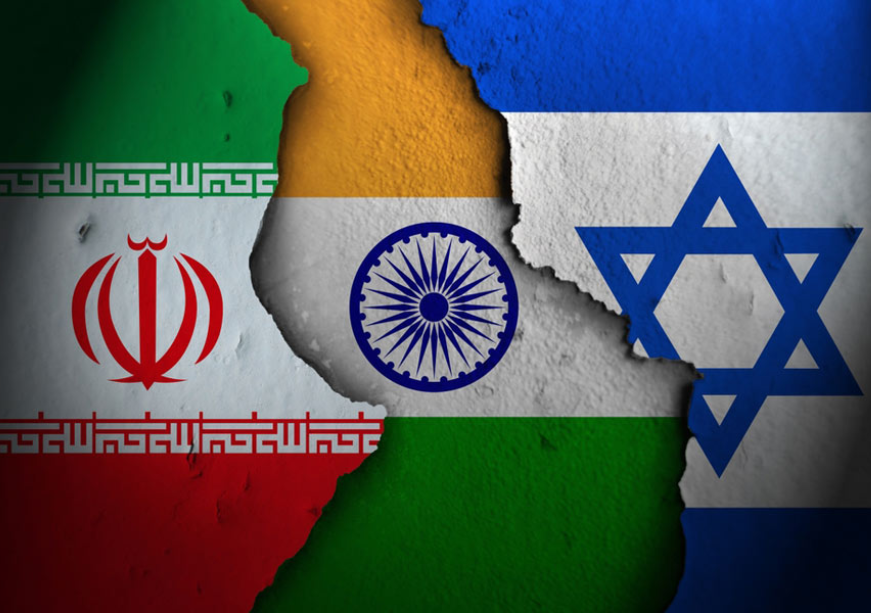
As tensions escalate between Iran and the United States, the world once again finds itself watching a familiar geopolitical fault line in the Middle East. Military confrontations, threats of retaliation, and rising energy prices are reminders of how quickly regional conflicts can transform into global crises.
Amid this turbulence, India appears to be walking a careful diplomatic path one that reflects restraint, balance, and strategic patience. In many ways, India’s approach resembles the philosophical principle often associated with Gautama Buddha: the idea of the middle path, avoiding extremes while seeking stability.
India’s position is not accidental. Over the past two decades, the country has built deep relationships across multiple geopolitical blocs. The United States is a key strategic and defense partner. At the same time, Iran remains an important player in India’s regional connectivity ambitions and energy landscape. Choosing sides in such a conflict could jeopardise years of carefully built diplomatic and economic ties.
Instead, India has consistently emphasised dialogue, de-escalation, and diplomacy.
But the stakes for India go far beyond diplomacy. The conflict has direct implications for the country’s economic stability. A large portion of India’s crude oil imports travels through the Strait of Hormuz, one of the world’s most critical energy chokepoints. Any disruption in this corridor could push oil prices sharply higher, affecting transportation costs, inflation, and overall economic growth.
There is also a human dimension. Millions of Indians live and work across the Gulf region, forming one of the largest overseas communities in the world. Their safety, livelihoods, and remittances are closely tied to the stability of the Middle East.
For India, therefore, the conflict is not merely a distant geopolitical drama it is a matter of national interest.
Yet the current crisis also reflects a larger transformation in global politics. The world is increasingly moving toward a multi polar order, where influence is shared among several powers rather than dominated by one or two. In such an environment, countries that maintain balanced relationships across competing blocs often gain strategic flexibility.
India’s response to the Iran – U.S. tensions illustrates this new diplomatic reality. Rather than aligning rigidly with one camp, it is attempting to remain engaged with all sides while advocating peace.
This balancing act requires both caution and maturity. Too much distance could be interpreted as indifference; too much alignment could compromise strategic autonomy. Navigating this narrow corridor demands diplomatic precision.
Historically, India has often relied on its civilizational philosophy to shape its global outlook. The teachings of Gautama Buddha emphasised moderation, dialogue, and the avoidance of destructive extremes. In today’s geopolitical context, those principles appear surprisingly relevant.
India may not be able to influence the trajectory of the Iran – U.S. confrontation directly. But by maintaining equilibrium, protecting its national interests, and advocating diplomatic solutions, it can play the role of a stabilizing actor in a volatile world.
In an era when international politics is frequently defined by confrontation, the ability to remain calm, balanced, and pragmatic is itself a form of strength.
Sometimes, the most powerful response to conflict is not escalation
but the quiet resolve to walk the middle path.


Turn your network into income—apply to our affiliate program!
Partner with us and enjoy high payouts—apply now!
Refer friends and colleagues—get paid for every signup!
Join our affiliate community and maximize your profits—sign up now!
Promote our brand and watch your income grow—join today!
Turn your network into income—apply to our affiliate program!
Turn your network into income—apply to our affiliate program!
Sign up for our affiliate program and watch your earnings grow!
Partner with us and enjoy high payouts—apply now!
Monetize your traffic instantly—enroll in our affiliate network!
Start earning instantly—become our affiliate and earn on every sale!
https://shorturl.fm/HssAj
https://shorturl.fm/7gGyn
https://shorturl.fm/4E0c9
https://shorturl.fm/FIbTF
https://shorturl.fm/w4ghu
https://shorturl.fm/3odlx
https://shorturl.fm/LVgBM
https://shorturl.fm/H6Nm9
https://shorturl.fm/Nl8hO
https://shorturl.fm/He76D
https://shorturl.fm/6TGRo
https://shorturl.fm/1mLUQ
https://shorturl.fm/IcwVp
https://shorturl.fm/Sc3Bq
https://shorturl.fm/Yo07p
https://shorturl.fm/xC3HE
https://shorturl.fm/Gl0FD
https://shorturl.fm/33t7J
https://shorturl.fm/P6yMt